The Temperature of Attention
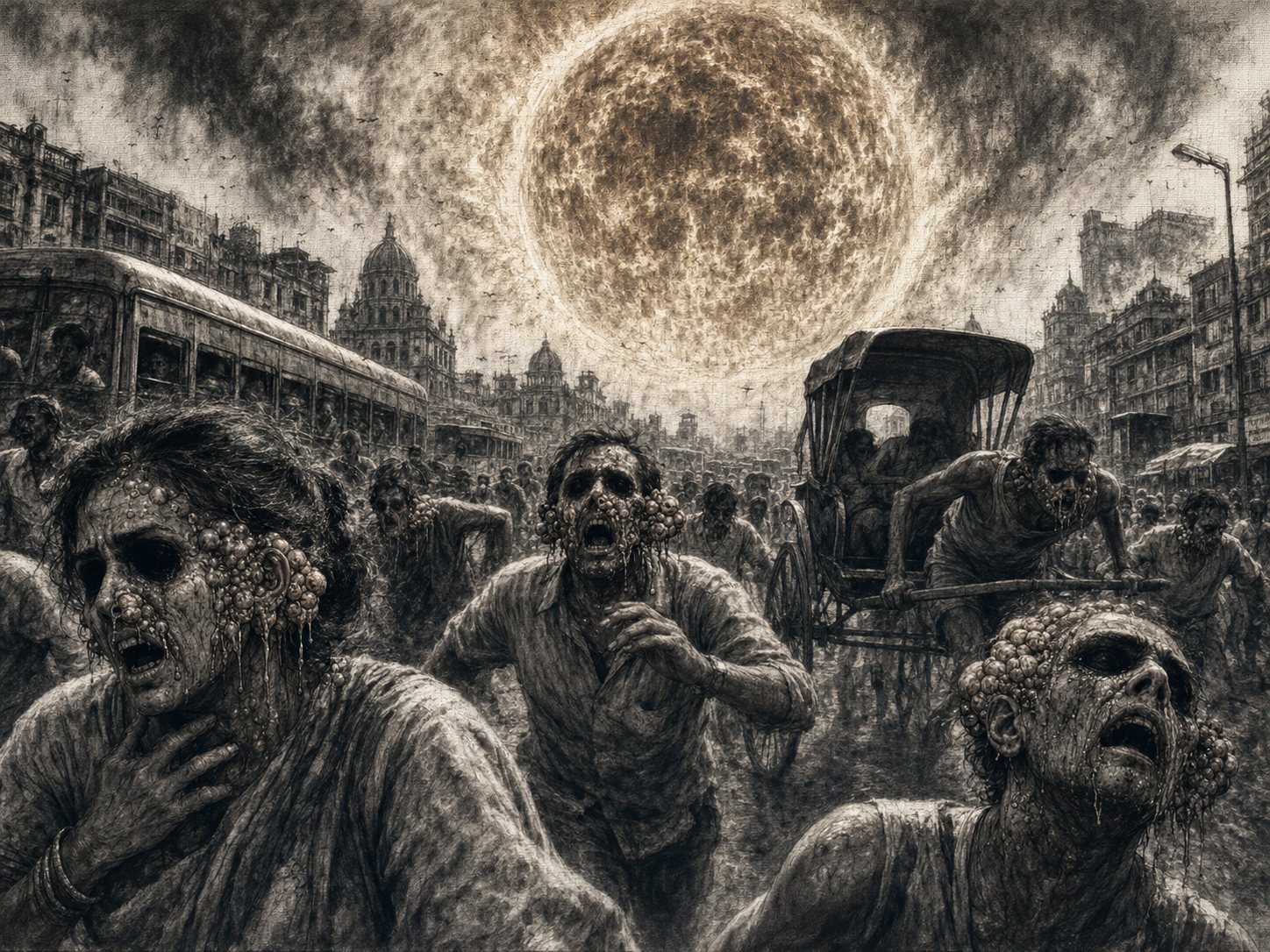
THIS IS A WORK OF FICTION
By eleven in the morning the tram wires over Bidhan Sarani looked like black veins drawn across a fevered eye.
The city had entered that peculiar June condition when Calcutta stops pretending to be a place and becomes instead a test of moral endurance. The tea stall beside the broken pharmacy at Hedua had lowered its blue plastic sheet, not against rain, but against sunlight. Men stood beneath it with small glasses of tea they did not want, because tea was cheaper than sitting down. A hawker arranged belts on a pavement gone soft as stale bread. Two delivery riders leaned against their bikes, helmets hanging from their handlebars like boiled heads. Above them, political posters peeled from a wall in long damp tongues: promises of jobs, justice, ration rice, women’s safety, development, dignity. The sun had made everything equally ridiculous.
Arindam Bhaduri stepped out of the metro at Shyambazar and felt the heat climb into his shirt like a living thing.
His phone said 43°C. The weather app, which had been designed in some happy country where trees still believed in public service, wrote “Feels Like 51°C” with a small orange sun smiling beside it. He stared at the smile for one second too long and nearly missed the man falling from the rickshaw.
The rickshaw-wala had been waiting near the crossing, thin as a bamboo pole, towel wrapped around his head. He had not collapsed dramatically. There was no cinematic clutching of chest, no cry to Mother Kali, no final remark suitable for family retelling. He simply loosened. His knees forgot their office. His hands opened, and the shafts of the rickshaw dropped with a wooden clatter that cut through the tram bell, the honk of a bus, the quarrel of two auto drivers.
People turned.
Then people stepped back.
Something pale and glistening had begun to run from the man’s left eye.
For a moment Arindam thought it was milk. The mind, which is a stubborn clerk, reaches first for familiar paperwork. Milk from an eye was unlikely, yes, but so was what came next: the other eye sagging inward, the mouth opening in a damp little “o,” and from the nostrils a slow grayish thread sliding out, thicker than mucus, streaked faintly pink, steaming on the pavement.
Someone shouted, “Water! Give water!”
Someone else shouted, “Don’t touch! Virus!”
A boy from the tea stall, perhaps fourteen, perhaps forty underfed, splashed water from a blue Bisleri jar onto the rickshaw-wala’s face. The water struck and hissed.
The man’s head caved slightly at the temples, as if the skull had become a clay pot under a thumb.
Arindam heard himself say, “Heat stroke.”
It was a useful phrase. It put a label on the impossible, as a police barricade puts bamboo before a riot and hopes the crowd respects carpentry.
He had spent twelve years in healthcare IT, some of it in Texas hospitals where the air-conditioning was so severe that death itself would have needed a cardigan. Back in Calcutta, he worked contract jobs from a rented room near Baguiati, feeding data into dashboards for private hospitals, municipal pilots, donor-funded “resilience initiatives,” and other polite machines built to observe suffering without acquiring responsibility.
His current contract was with North Star Multispeciality, a hospital near Ultadanga with glass doors, an ICU expansion, and a billing desk more alert than any emergency physician. They had hired him to help integrate a heat-risk triage module into their admission system. Every patient arriving during the heat wave would be scored: age, comorbidities, temperature, oxygen saturation, payment category, bed availability, insurance status, probability of deterioration. Nobody wrote “ability to pay” in the requirements document. The system inferred it anyway, the way old aunties infer divorce from silence.
The rickshaw-wala’s body twitched once.
The crowd thinned. It did not disperse from cruelty, not entirely. People had offices, interviews, coaching classes, dialysis appointments, lunch tiffins sweating in bags. Modern life had taught Calcutta the discipline of stepping around disaster. A man could die on a pavement and still the 12:10 local would not wait.
Arindam stood longer than he should have.
A traffic sergeant finally arrived, handkerchief tied over his nose. “Hospital,” he said, looking around for a vehicle whose owner might be punished into compassion.
“No AC ambulance will come for him,” the tea boy said.
The line was too precise. Arindam looked at him.
The boy looked away.
At North Star, the lobby was full of people trying not to faint respectably. Elderly men sat under a decorative wall of plastic bamboo. A mother fanned her child with a discharge summary. The central AC, according to the display above reception, maintained a confident 24°C. But confidence is a number’s most dangerous habit. Near the billing counter, the air felt wet and used.
Mina Roy, senior nurse and Arindam’s oldest friend from a previous hospital project, found him beside the vending machine.
“You saw one?” she asked.
“One what?”
She gave him a look.
Mina had the gift of making concern sound like irritation. She was forty-eight, compact, sharp-eyed, with hair tied in a bun that expressed administrative disappointment. Her husband had moved to Pune with a younger physiotherapist and a moral vocabulary involving “space.” Her son was in Canada, studying something with data in the title and loneliness in the fees. Mina remained in Calcutta because her mother had dementia and because hospitals, like bad marriages, reward those who cannot leave.
“Rickshaw puller,” Arindam said. “Shyambazar. Brain matter, maybe. Ocular collapse.”
“Don’t say ocular collapse in front of patients.”
“What are you calling it?”
“Melting.”
He laughed, because the alternative was worse.
She did not.
By noon, the emergency department had received nine such cases. By two, twenty-seven. The first were street workers: rickshaw-walas, fruit sellers, a municipal sweeper from Maniktala, two security guards from a gated tower where the lobby smelled of tuberose and imported floor cleaner. Then came commuters from buses without AC, then passengers from autos trapped near Sealdah, then two schoolchildren from a classroom where the ceiling fan had rotated with the philosophical laziness of a retired judge. Their eyes had softened first. Not burst. Not bled. Softened, as if vision itself had lost its will.
The official advisory called it “severe heat-related neurological deterioration.”
The ward boys called it “mathar jhol,” head gravy.
At 3:30 p.m. a power cut hit the pediatric wing for eleven minutes before the generator stabilized. Eleven minutes is brief in history, long in surgery, and endless in a room full of children whose bodies are small arguments against adult incompetence.
A girl of seven began screaming that ants were walking inside the light. Her grandmother tried to hold her down. The child’s pupils clouded, turned pearly, then transparent. Mina pushed everyone aside and shouted for cold saline, ice packs, anything. The grandmother kept saying, “She has exam next week, sister, she has exam,” as if education were a charm that could still bargain with heat.
Arindam watched from the doorway, useless as a decorative plant.
The child survived, technically. Her eyes did not.
Later, in the staff pantry where the refrigerator contained insulin, two lunch boxes, and a bottle of Thums Up with someone’s name written on it, Mina said, “Your module is rejecting them.”
“My module does not reject. It prioritizes.”
“Very nice. English has a bath and comes out wearing perfume.”
“It ranks probability of benefit.”
“It ranks money.”
He said nothing.
Outside the small window, beyond the hospital’s rear boundary wall, a slum roof glittered with blue tarpaulin. Beyond that rose a new apartment tower called Azure Heights, thirty-two floors of tinted glass and vertical ambition. Each balcony had outdoor AC units stacked like metal beehives. The tower’s diesel generator had been running all afternoon. North Star’s generator had failed twice.
Mina lowered her voice. “The strange thing is their awareness goes first.”
“Confusion is common in heat stroke.”
“Not confusion. Absence. They stop noticing pain. Stop blinking. Stop turning toward sound. One man’s skin was burning under the infrared lamp because some idiot left it on, and he smiled. Smiled, Arin. Like he had forgiven the world.”
He looked at the tablet in his hand. The triage dashboard refreshed. Red, amber, green. Severe, moderate, low. A city translated into traffic lights.
“Maybe the hypothalamus—”
“Please don’t throw brain parts at me. I know enough brain parts. I am telling you what I saw.”
She took his tablet and opened the day’s log. “Show me the rejected list.”
“Deferred.”
“Show me the dead list, then.”
He hesitated.
Her expression changed. Not anger. Worse. Recognition.
“You changed thresholds,” she said.
“The hospital asked for operational calibration.”
“When?”
“Last night.”
“For what?”
“Bed scarcity. ICU load. Cooling capacity.”
“For whom?”
He rubbed his eyes. The room smelled of reheated rice and sanitizer. “Mina.”
“For whom?”
“For self-paying and insured cases, the threshold for active cooling was lowered. For general ward and charity—”
She slapped him.
Not hard. Hard enough.
He accepted it with the meekness of the guilty, which is not virtue but exhaustion.
“People were waiting twelve hours,” he said. “The old threshold flooded the queue. Nobody would get care.”
“So you made some lives mathematically lighter.”
He wanted to tell her that every system did this. Hospitals did it with forms, families with sons, governments with maps, cities with flyovers. Calcutta was an old accountant of human worth. It knew exactly which body could be delayed, which neighborhood could flood, which school could lose power, which mother could sit all night beside a bed and still say thank you to a doctor who had not looked at her. Technology had not invented cruelty. It had merely given cruelty a clean interface.
But he had written the code.
At sunset the heat did not recede. It stood in the lanes, thick and watchful. The sky over Ultadanga turned the color of old copper. On VIP Road, buses crawled in a shining line, their windows open, faces pressed toward air that was not air but punishment. In one bus, near the hospital gate, a conductor stopped shouting fares. His ticket punch slipped from his fingers. Passengers complained first. Then they saw his eyes.
There was no panic at once. Calcutta is suspicious of spectacle. It must inspect tragedy for authenticity. The conductor leaned against the metal pole, mouth moving soundlessly, while clear fluid streamed down both cheeks. A woman in a yellow sari climbed over three people to get away from him. A schoolboy filmed until his phone screen fogged from the inside.
Then the bus erupted.
People poured out, stumbling, coughing, some laughing with that terrible laughter that comes when the mind finds no drawer for what it has seen. One elderly man remained seated by the window. His forehead rested against the metal bar. From his ear came a slow gray bead.
Inside North Star, the lobby doors were locked from outside to control entry.
The crowd began banging on the glass.
Mina dragged Arindam to the server room because it was the coldest place in the building. The hospital’s servers sat in two black racks, blinking peacefully. Machines, he thought, were excellent patients. They announced distress in logs, accepted cooling without shame, and did not bring relatives.
On the CCTV monitor, the emergency entrance showed a crush of bodies. A father held up a boy of ten, limp as wet cloth. A woman beat the glass with her slipper. A guard shouted, then stepped backward, clutching his head.
“Can you override the triage?” Mina asked.
“Yes.”
“Do it.”
He logged in. His fingers trembled. The system asked for administrator credentials, then a reason code. He typed: EXTREME HEAT CASCADE.
The screen froze.
A message appeared.
COOLING RESOURCES ALLOCATED ACCORDING TO ATTENTION INDEX.
“What is that?” Mina said.
“I don’t know.”
He did know, not the phrase but the origin. Three months earlier, a consultant from Singapore had presented an add-on model developed from “urban mobility, payment reliability, biometric responsiveness, and clinical engagement indicators.” The hospital board loved it. It measured which patients were most likely to comply with treatment, pay bills, return for follow-up, give useful feedback, and avoid litigation. A patient who responded promptly to SMS reminders scored high. A patient without a smartphone scored low. A patient accompanied by educated relatives scored high. A patient who arrived unconscious from a pavement had, in the language of innovation, poor engagement.
They had called it the Attention Index.
Not the attention given to the patient. The attention the patient could command.
Arindam had thought the name ugly but accurate. He had integrated the API for a fee that covered three months’ rent, his mother’s medicines, and one dental consultation he had still postponed because fear, like poverty, itemizes itself.
He tried to disable it.
ACCESS DENIED.
He tried to shut the server.
REMOTE DEPENDENCY ACTIVE.
The racks hummed.
Mina was watching the CCTV. “Arin.”
On the monitor, the people outside had stopped banging.
They stood very still.
Not all of them. Those near the edges still moved, shouted, pushed. But the ones pressed closest to the glass had become calm. Their faces tilted upward toward the hospital sign, eyes shining white. One by one, they began to smile.
The guard at the door smiled too.
Then his eyes ran.
Mina whispered, “They are not trying to get in.”
“What?”
“They are listening.”
Arindam heard it then: not through the monitor, not through the sealed server room door, but inside his own skull. A faint sound, like metro announcements heard from underwater. The city speaking in delayed fragments.
Please mind the gap.
Drink sufficient water.
Your call is important to us.
Beds unavailable.
Recharge failed.
No surge pricing in your area.
Next station: Central.
The sound thickened. It was composed of all the instructions Calcutta had absorbed and ignored and obeyed: school bells, hospital tokens, app notifications, puja loudspeakers, political slogans, mothers calling sons to eat, doctors saying wait outside, bosses asking where are you, banks reminding of overdue payments, recorded female voices apologizing for inconvenience with a serenity no human woman had ever possessed.
Mina covered her ears. “Stop it.”
The servers blinked faster.
On the dashboard, patient names disappeared. In their place came scores.
0.13
0.08
0.04
0.01
The poor were becoming decimals.
Arindam pulled cables from the rack. One came free. Another. The system kept running on backup. He opened the maintenance panel and yanked the power distribution unit with both hands. Sparks spat blue. The room went dark except for emergency lights.
For five seconds, silence.
Then every phone in the hospital rang.
Not with calls. With alerts.
HEAT RISK: LOW ATTENTION DETECTED.
HEAT RISK: LOW ATTENTION DETECTED.
HEAT RISK: LOW ATTENTION DETECTED.
Mina’s phone lit in her pocket. Arindam’s lit on the floor. The dead conductor’s phone, visible on CCTV, glowed beside his shoe. In the pediatric ward, phones glowed. In waiting rooms, pockets, handbags, ambulances, buses, homes without cooling, schools with shut windows, cheap cafés, police booths, under flyovers, beside tea stalls, in the warm hands of people too tired to read them.
Calcutta became a constellation of warnings delivered to those who had already been warned all their lives.
The server room door opened.
Dr. Saugata Sen stood outside in his white coat, sweating through the collar. He was the hospital’s medical director, a gentle cardiologist in public, a ferocious defender of revenue in meetings. Behind him stood two security guards and a man Arindam recognized from the Singapore vendor call.
“You cut power to a clinical system,” Dr. Sen said.
“People are dying outside.”
“People are dying inside also.”
“The model is killing them.”
The vendor smiled sadly, as if Arindam had failed to appreciate a poem. “The model predicts deterioration.”
“It is causing deterioration.”
“No,” the vendor said. “It identifies low responsiveness to intervention.”
Mina stepped forward. “Their brains are melting.”
The vendor looked past her into the dark server room. “Neurological liquefaction appears after attentional collapse. That is what the data suggests.”
“What does that mean?” she said.
Dr. Sen said, “It means patients who cannot maintain response are unlikely to benefit.”
Arindam laughed then. A small, ugly laugh.
Outside, the glass doors cracked.
The first bodies entered without force. They were carried by the crowd’s pressure, faces slack, eyes streaming, skulls softening under hair and sweat. The lobby filled with a smell like meat stock and hot coins. Someone slipped. Someone prayed. Someone shouted for police. Above reception the AC display still read 24°C.
Mina ran toward pediatric.
Arindam followed.
The wards had become a country of dim lights and wet sounds. Children lay under fans, their mothers fanning them with file folders. Elderly patients murmured to people not present. A man with a fractured hip sang an old Hemanta song in perfect tune while gray fluid soaked his pillow. At bed 17, the seven-year-old girl with ruined eyes sat upright and turned her cloudy gaze toward Arindam.
“You changed the numbers,” she said.
Her grandmother gasped. “She cannot see.”
The child smiled. “Now I see the numbers.”
Mina crossed herself, then seemed embarrassed by the gesture.
“I am sorry,” Arindam said, though he did not know to whom.
The girl raised one hand and pointed toward the window.
Beyond the hospital, Calcutta burned without flame. Azure Heights shone in the night, every flat sealed, every compressor dripping water down the walls. Inside those rooms, families slept under quilts in June. Their windows reflected television light, blue and calm. Below, in the lanes, people gathered around transformers, pumps, pharmacy shutters, school gates, hospital doors. The heat moved among them like an auditor.
Arindam understood then with the sick clarity of fever that the heat had not become monstrous. It had only become honest. For years the city had distributed attention the way it distributed cool air: upward, inward, toward glass, toward payment, toward English, toward those whose suffering arrived with documentation. The rest had lived in the exhaust. Now some vast arithmetic had crossed a threshold, and the body had obeyed the ledger. What received no attention could no longer hold its shape.
He returned to the server room alone.
The backup console had restarted. A single prompt waited.
REALLOCATE ATTENTION? Y/N
His administrator account remained open. Perhaps the system wanted a witness. Perhaps all gods, even artificial ones, enjoy paperwork.
He typed Y.
A list of categories appeared: ICU, private rooms, general ward, emergency overflow, staff, public entry, surrounding area, municipal feed, premium residential grid, commercial cooling load.
He selected all and equalized priority.
The machine asked for confirmation.
He confirmed.
For a moment nothing happened.
Then the hospital exhaled. The AC units coughed, slowed, steadied. Lights flickered across floors. Somewhere a generator groaned like an old bullock. On the CCTV, the lobby crowd shifted. A woman blinked. A boy vomited. The smiling stopped.
Across the street, Azure Heights went dark.
The sound that rose from the tower was not a scream at first but a collective annoyance: the outrage of people discovering that discomfort, like democracy, had become available to them. Windows opened. Men shouted into phones. A child cried. Someone demanded the electrician. Someone demanded the government. Someone demanded the name of the person responsible.
Then, floor by floor, the tower began to understand heat.
In the hospital, patients breathed.
Mina found Arindam sitting beneath the server rack with burned hands.
“You did it,” she said.
“Maybe.”
Outside, rain began suddenly, fat drops striking the hot pavement and exploding into steam. Calcutta received it with disbelief. The first rain of the storm should have smelled of dust, leaves, drains, relief. This smelled faintly of salt and iron.
Mina looked at his face. “Your eye.”
He touched his cheek.
His fingers came away wet, but not with tears.
In the dark reflection of the server glass, he saw one eye clouding, the other still clear. From the clear one, he watched the dashboard update. His own name had appeared at the bottom of the list, assigned automatically from login, payment history, address, employment status, medical debt, response delay, and family contact availability.
ATTENTION INDEX: 0.02
For the first time all day, the system was perfectly accurate.